No Mans Land and The Führerbunker 1986-1988

January 28, 2025

Wooden platforms in West Berlin during the 1980s offered views over the Berlin Wall and into the East German-controlled “No Man’s Land”. Also known as the “death strip” this open area between the inner and outer areas of the Berlin Wall prevented East Berliners from escaping to West Berlin.
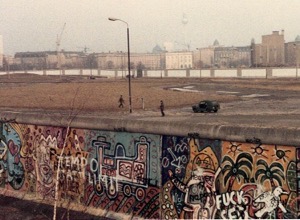
 

East German border guards monitored the “death strip” by patrolling the area on foot, in a vehicle, or from watchtowers. Floodlights, motion detectors, tripwires, alarm systems, mines, barbed wire and guard dogs helped to detect escape attempts. 
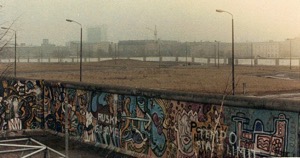
Besides all the surveillance equipment and security forces, the “death strip” was also home to Adolf Hitler’s Führerbunker. The Führerbunker is where Hitler spent his last days and died in 1945. If you examine the two pictures of the death strip, you will see a mound on the left side about 1/3 of the way from the top. The mound is the remnants of the Führerbunker.

The bunker remained buried and inaccessible until 1987 – 1989. Crews building residential housing and other buildings uncovered sections of the bunker. Damaged sections were filled and sealed, and other sections were destroyed. While the bunker was still standing, but before its scheduled destruction, Robert Conrad, a photographer, risked discovery by repeatedly sneaking into the dark bunker to capture photographs.

In the end, the old bunker complex was mostly destroyed during reconstruction. Any remains of the bunker lie underneath a parking lot. The few existing corridors remaining are sealed off from the public. In 2006, an information board was installed to mark the location of the bunker. Rochus Misch, who was in the bunker at the time of Hitler’s suicide, attended the ceremony of placing the information board. 


La Belle Discothèque bombing, April 5, 1986, West Berlin

January 27, 2025

An explosion at the La Belle discotheque shattered the early morning hours of April 5, 1986, as a bomb hidden beneath the DJ booth ripped through the building at 1:45 AM. Among the deceased were Nermin Hannay, a Turkish woman, and Sgt Kenneth T. Ford CSC 4/502. Critically injured, Sgt James E. Groins CSC 4/502 died of his injuries two months later. At least 230 individuals, including over fifty American service members, suffered injuries. 

I think, and after thirty-eight years, I may be mistaken, my unit had been training in Bonnland, West Germany, when the La Belle bombing happened. I found out about the bombing when we returned to Berlin a few days later. The La Belle bombing injured a few members of my unit, 6/502nd.

The bombing left us with an unsettling question—who was responsible? A Berlin police detective I knew told me that Libya was behind the bombing. Just a few days later, on April 14, 1986, Operation El Dorado Canyon, targeted Muammar Gaddafi’s Bab al-Azizia compound.

Even though some articles claim Germany did not have any evidence of who handled the bombing, my Berlin police detective led me to believe otherwise. Just recently, I learned of a few pieces of information I didn’t previously know. Signal Intelligence (Stejskal, 2020) captured between “Libya and the Libyan People’s Bureau—it’s embassy—in East Berlin indicated prior knowledge and subsequent approval of the attack by Col. Moammar Gadhafis government.” (U.S. Delays Underlined as Disco Bombing Suspect Is Freed in Lebanon, 1994).

After the reunification of Germany, the Stasi Records implicated Musbah Eter, leading to his indictment for aiding and abetting attempted murder in the La Belle bombing. The court also indicted and convicted two others—Palestinian Yasser Mohammed Chreidi and Lebanese-born German Ali Chanaa.

Libya eventually compensated Germans, wounded by the bombing, and the family of the Turkish woman who was killed. Americans were not part of the compensation settlement. 


References: 

Malinarich, N. (2001, November 13). Europe | flashback: The Berlin Disco bombing. BBC News. http://news.bbc.co.uk/2/hi/europe/1653848.stm 

Stejskal, J. (2020). Special forces berlin: Clandestine cold war operations of the US Army’s elite, 1956-1990. Casemate. 

U.S. delays underlined as disco bombing suspect is freed in Lebanon. (1994, August 2). https://www.archives.gov. https://www.archives.gov/files/research/foia/garland/8001832_Box2_Folder20.pdf


Book Recommendation: The Spy Coast by Tess Gerrutsen

January 26, 2025

The Spy Coast is a fun, fast-paced thriller.

Maggie Bird, a CIA operative, retired in a small coastal town in Maine. A murder in her small town, linked to an old covert operation, pulled her back into the life she left behind. Ex-spies teamed up with Maggie to unravel secrets, while Maggie also dealt with the fallout of choices she made long ago. 

Maggie is not the typical spy. She’s older, more experienced, and carries the emotional scars from past work. The author, Tess Gerritsen, explored themes like aging, redemption, and regret, which gave Maggie depth.

The book is fast-paced but balances the action scenes with reflective moments so readers can connect with the characters. 

I recommend The Spy Coast to anyone looking for an exciting thriller that also has heart, spirit and an unforgettable protagonist. 

Book Recommendation: Stasiland: Stories from behind the Berlin Wall by Anna Funder

January 25, 2025

From 1985 to 1988, I served as a soldier in the United States Berlin Brigade, which was in the American sector of West Berlin. While there, I visited East Berlin a few times. The difference between West Berlin and East Berlin stood out to me. The infrastructure, consumer products and urban aesthetic in East Berlin paled compared to West Berlin. In the East, there were visible East German Police within a block or two of each other. I always felt watched.

I stumbled on the book Stasiland by Anna Funder when I came across an article that mentioned the Stasi Archives, which became accessible to the West once the wall fell.

Funder’s book is a thought-provoking read, which balances journalism with human stories. Funder interviewed former Stasi officers and the ordinary people who had to live their life under surveillance. A society built on fear and mistrust takes a psychological toll on its citizens.

Funder’s writing is informative and although the book is about historical events, the personal stories in a historical context ensure the book is engaging. For those fascinated by the Berlin Wall or the experience of living under a centralized, dictatorial state, Stasiland is an excellent choice.

If you value freedom and truth, you may find this book relevant to events in today’s world.

Random Quote

January 23, 2025

“People are always getting ready for tomorrow instead of living for today.” – Source unknown

The Berlin Wall: A Cold War Legacy Explored

January 22, 2025

The Allies, after World War II, split Berlin into four zones, with the British, the French, the Americans and the Soviets each occupying a zone.

The East German government, in 1961, built the Berlin Wall, which prevented East Berliners and East Germans from accessing West Berlin. 

Picture taken ~ 1986 on the west side of the Berlin Wall, near Checkpoint Charlie. Pictured: Dan Reid and Keith Green.

The mission of deterring aggression and the defense of West Berlin from the East German Military and the Soviet Union fell to the US Berlin Brigade along with the French and British forces station in West Berlin. 

From 1985 to 1988, I served with the US Berlin Brigade. We specialized in Military Operations in Urban Terrain (MOUNT). However, if the East German army and the Soviets (hundreds of thousands of soldiers) attacked West Berlin, the allied forces (~12,000 soldiers) would hold out from a few days to about a week. 

I’m not aware of anyone that believed the East Germans and the Soviet Union would attack West Berlin. No one wanted a full-scale nuclear war. I was wrong. 

The Berlin Wall fell in 1989, and Germany started reunification. The fall of the Berlin Wall meant the Stasi, the East German secret police and intelligence agency, files were available to the public. 

According to the Stasi files, the Stasi and the East German army had plans for the invasion of West Berlin, which included dividing the conquered West Berlin into Stasi branch offices, the number of men to assign to each branch and they even cast medals to award after a successful invasion. (Funder,2014, p. 72).

An invasion of West Berlin depended on Soviet approval and support. The party chairman and the leaders of the Soviet Union would not give their approval or support without a decisive military edge for an offensive war. The economic condition of the communist economy and the cost of the arms race finally caused the Soviet leadership to reject an offensive war in 1987. (Wenzel, 1994)

References:

Funder, Anna. Stasiland: Stories from Behind the Berlin Wall. Kindle Edition. 

Wenzel, O. (1994). East German plans for the conquest and occupation of west … – ciar.org. http://ciar.org/ttk/mbt/armor/armor-magazine/armor-mag.1994.nd/6berlin94.pdf

Rules are made to be broken

January 21, 2025

A rule I learned as a young boy was the importance of silence when fishing; the slightest sound could scare away the fish.

During a fishing trip with my brother and uncle, the fish quit biting.

My uncle picked up some rocks and tossed them in the pond. “Let me stir the fish up.”

The fish started biting again.