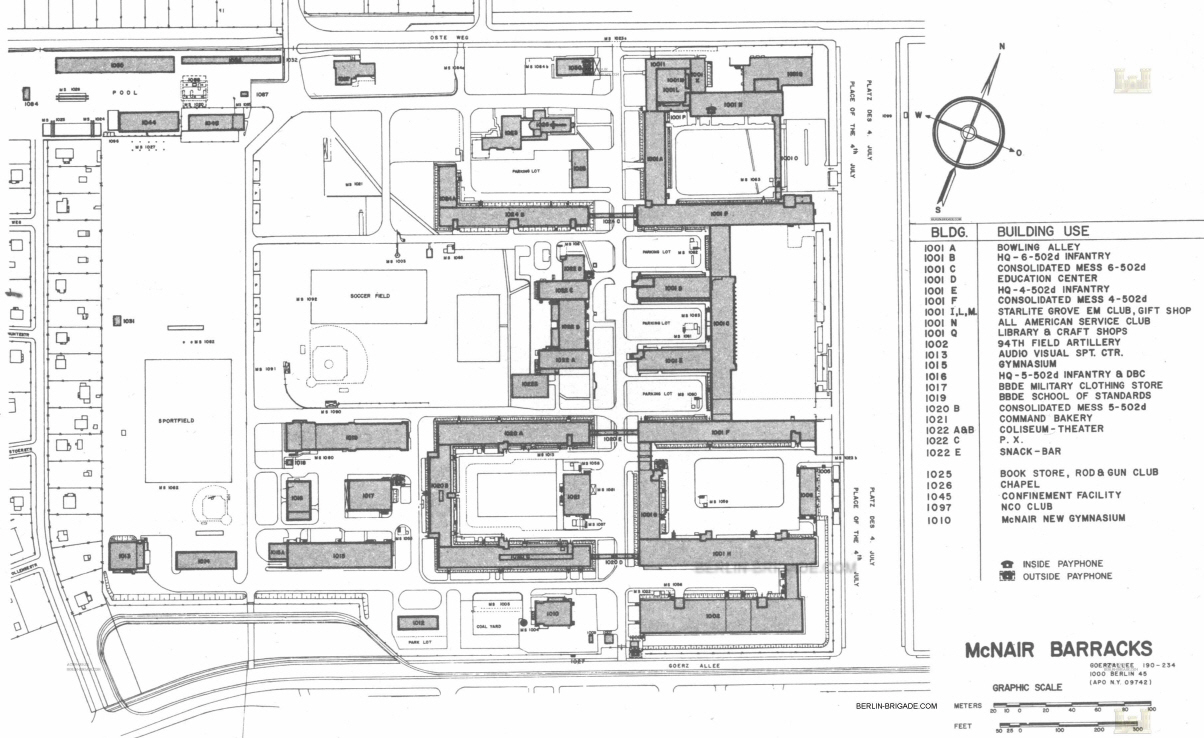
The Telefunkenwerk Zehlendorf produced radar, transmitters, and other military electronic devices for the Third Reich. The factory employed 400,00 forced laborers, French and Polish prisoners. In 1945, the US Army occupied, used and expanded the factory and renamed it McNair Barracks. In 1985, when I arrived in West Berlin, McNair comprised three infantry battalions and a field artillery unit.
Training:
The infantry battalions did not always deploy. When they were not deployed, the units still trained on McNair. Preparing for the Expert Infantry Badge (EIB) testing and the Skills Qualification Test happened every year. Every few months, an alert tested how quickly we could be ready to conduct military missions. I don’t remember the unit’s required readiness time, but the time varied depending on whether the unit belonged to a Quick Reaction Force. Every quarter we forced marched for twelve miles with a full combat load. The forced march had to be completed in three hours or less, and then random inspections would make sure the soldiers were packing according to the unit standard operating procedure. In 1988, Rambo stopped by during EIB training.
We qualified on our weapons at Rose Range. Rose Range could only handle a few shooters at one time. We fired the M16, M1911, and M60 at Rose Range. Keerans Range was also a qualification range, but I don’t recall shooting there.
Occasionally we trained in the Grunewald which was one of the largest forested areas in West Berlin. This training typically comprised conventional army training, e.g. set up positions, perform recons, attack “enemy positions”, etc. Sometimes spouses or dependents of soldiers would play along and try to sabotage our area of operation.
The Ruhleben Fighting City in the British sector is where the British military practiced their Military Operations in Urban Terrain (MOUT). I can only recall training there one time. When the British and Americans paired off against each other in MOUT training, both sides were out to win. Win or lose, we all came out of that exercise with new bruises.
Parks Range in the American Sector was also called Doughboy City. American units practiced their MOUT training in Doughboy City. Doughboy City had concrete buildings, a sewer system, and an S-Bahn for training. Today, the buildings do not exist. The German government tore the buildings down when the American forces left Berlin in 1994.
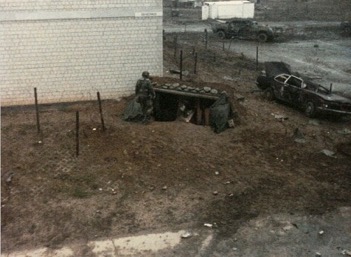
Soldiers preparing a fighting position in Doughboy City. I think this is for a 90mm Recoilless Rifle e.g. anti-tank weapon.
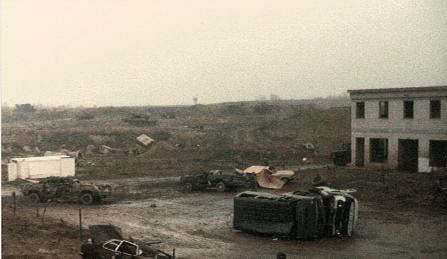
A portion of Doughboy City. If you look closely in the middle where the hill stops you can see an East German guard tower.
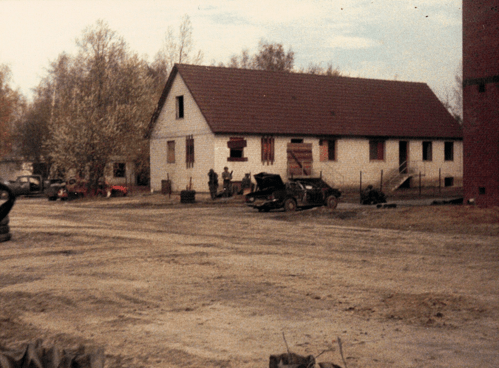
Another angle of the first picture. The soldiers are preparing to defend the city from another battalion.
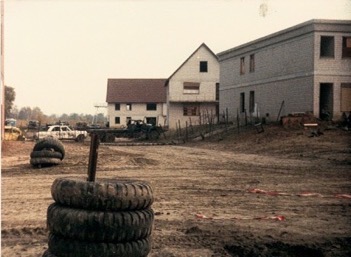
One last view of Doughboy City. The tires in the picture will eventually be set on fire causing a thick black smoke. (May not have been healthy breathing that!)
The poles have wire, either barbed or concertina to slow down the enemy forces or channel them where we want them to go.
Training outside of Berlin:
So, you may be wondering, what exactly does the West Berlin infantry battalions have in common with Hogan’s Heroes? Hogan’s Heroes is set in Hammelburg Germany and just outside of Hammelburg there was a POW camp call Stalag 13. We trained in Hammelburg. Cool huh? Ok the connection may be pretty thin but I encourage you to read the linked pages – did you know there was a real Colonel Klenk? The MOUT training area called Bonnland is a German training area in Hammelburg.
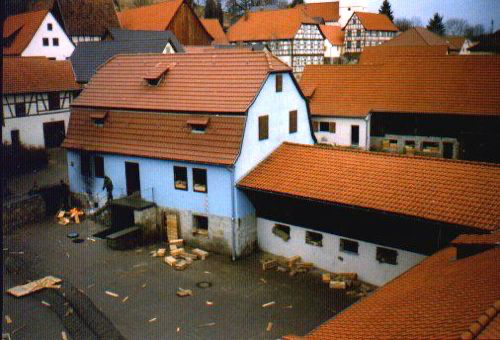
Bonnland
(Image thanks to Denny Sander, CC-by-SA license.)
The buildings in the Bonnland training area seemed more real than the buildings at Doughboy CIty and the Ruhleben Fighting City. For one exercise we built Molotov cocktails, after a tank rolled over us, we would jump and simulate tossing the cocktail into the hatch of the tank. Very cool way to build confidence!.
German Infantry training in Bonnland
In the next blog post I’ll cover one more training area in West Germany, One in Italy, and then circle back to Berlin to finish off a few more pictures.

 Terry Ebaugh