I’ll finish up the second part of the West Berlin post soon.
Until then, if you are a history buff, I encourage you to check out The Autodidact Professor’s website. The website covers many topics logically grouped into the Ancient Kings: Builders of Civilization, Chronicles of the Crown, Roman Emperors, Turning Points, and Cultures and Civilizations.
My second recommendation is to check out Pulphouse magazine. Pick up a copy, and if you like, it subscribe to it. I just finished a six-month subscription and renewed for another year. Pulphouse is one of the few magazines I’ll read cover to cover. Issue #37 showed up tonight and the title of the first story is “The Dragon with the Girl Tattoo” a very fun read. Pulphouse is not genre specific, you will never know which genres will show up in the latest issue, you will only know they are quality short stories.
In the Shade of the Slowboat Manis my pick for this week’s short story. Nominated for a Nebula in 1997. A quick read. The Amazon description summarizes the story giving nothing away. “For a vampire, saying goodbye to your mortal lover can be the hardest thing you ever have to do.”
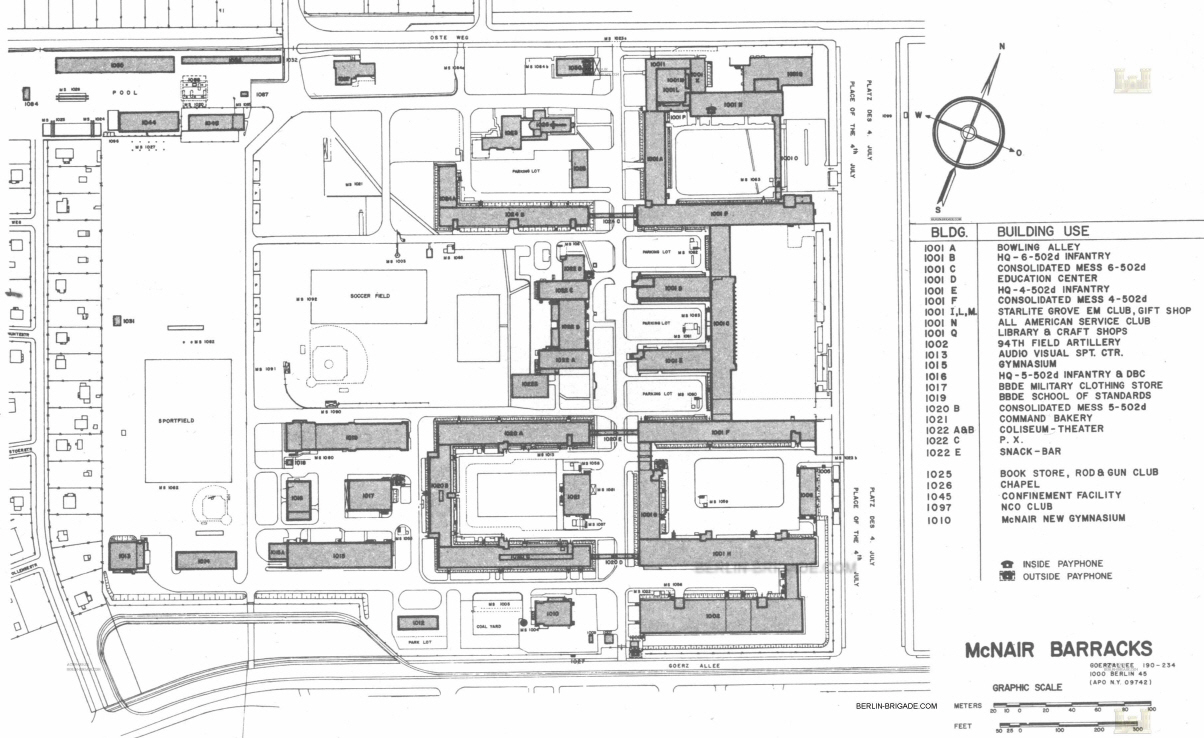
The Telefunkenwerk Zehlendorf produced radar, transmitters, and other military electronic devices for the Third Reich. The factory employed 400,00 forced laborers, French and Polish prisoners. In 1945, the US Army occupied, used and expanded the factory and renamed it McNair Barracks. In 1985, when I arrived in West Berlin, McNair comprised three infantry battalions and a field artillery unit.
Training:
The infantry battalions did not always deploy. When they were not deployed, the units still trained on McNair. Preparing for the Expert Infantry Badge (EIB) testing and the Skills Qualification Test happened every year. Every few months, an alert tested how quickly we could be ready to conduct military missions. I don’t remember the unit’s required readiness time, but the time varied depending on whether the unit belonged to a Quick Reaction Force. Every quarter we forced marched for twelve miles with a full combat load. The forced march had to be completed in three hours or less, and then random inspections would make sure the soldiers were packing according to the unit standard operating procedure. In 1988, Rambo stopped by during EIB training.
We qualified on our weapons at Rose Range. Rose Range could only handle a few shooters at one time. We fired the M16, M1911, and M60 at Rose Range. Keerans Range was also a qualification range, but I don’t recall shooting there.
Occasionally we trained in the Grunewald which was one of the largest forested areas in West Berlin. This training typically comprised conventional army training, e.g. set up positions, perform recons, attack “enemy positions”, etc. Sometimes spouses or dependents of soldiers would play along and try to sabotage our area of operation.
The Ruhleben Fighting City in the British sector is where the British military practiced their Military Operations in Urban Terrain (MOUT). I can only recall training there one time. When the British and Americans paired off against each other in MOUT training, both sides were out to win. Win or lose, we all came out of that exercise with new bruises.
Parks Range in the American Sector was also called Doughboy City. American units practiced their MOUT training in Doughboy City. Doughboy City had concrete buildings, a sewer system, and an S-Bahn for training. Today, the buildings do not exist. The German government tore the buildings down when the American forces left Berlin in 1994.
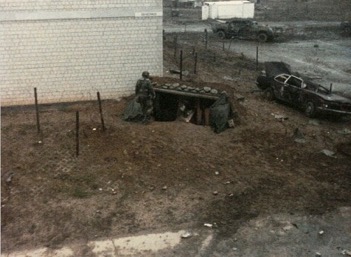
Soldiers preparing a fighting position in Doughboy City. I think this is for a 90mm Recoilless Rifle e.g. anti-tank weapon.
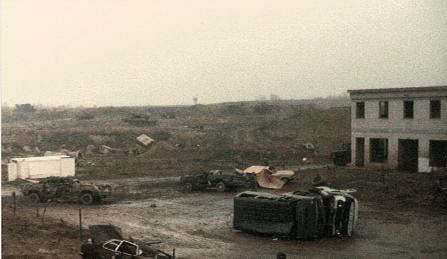
A portion of Doughboy City. If you look closely in the middle where the hill stops you can see an East German guard tower.
Another angle of the first picture. The soldiers are preparing to defend the city from another battalion.
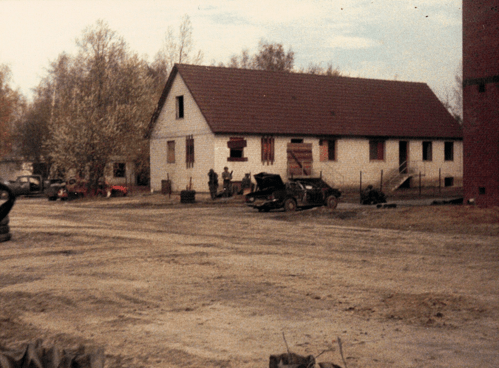
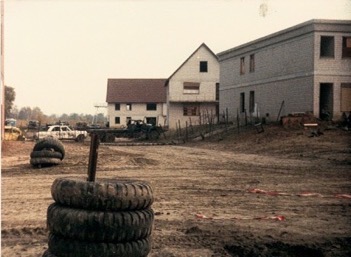
One last view of Doughboy City. The tires in the picture will eventually be set on fire causing a thick black smoke. (May not have been healthy breathing that!)
The poles have wire, either barbed or concertina to slow down the enemy forces or channel them where we want them to go.
Training outside of Berlin:
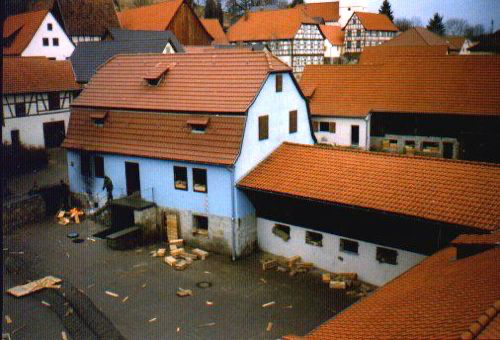
So, you may be wondering, what exactly does the West Berlin infantry battalions have in common with Hogan’s Heroes? Hogan’s Heroes is set in Hammelburg Germany and just outside of Hammelburg there was a POW camp call Stalag 13. We trained in Hammelburg. Cool huh? Ok the connection may be pretty thin but I encourage you to read the linked pages – did you know there was a real Colonel Klenk? The MOUT training area called Bonnland is a German training area in Hammelburg.
The buildings in the Bonnland training area seemed more real than the buildings at Doughboy CIty and the Ruhleben Fighting City. For one exercise we built Molotov cocktails, after a tank rolled over us, we would jump and simulate tossing the cocktail into the hatch of the tank. Very cool way to build confidence!.
German Infantry training in Bonnland
In the next blog post I’ll cover one more training area in West Germany, One in Italy, and then circle back to Berlin to finish off a few more pictures.
The website for the U.S. Department of Justice states independence and impartiality as one of their values. The value statement continues to say, “We work each day to earn the public’s trust by following the facts of the law wherever they may lead, without prejudice or improper influence.” (US Department of Justice, n.d.). On January 27th, 2025, The Justice department fired several lawyers involved in prosecuting Donald Trump. The Trump administration fired the lawyers, viewing them as untrustworthy enemies. Since the Department of Justice is part of the executive branch and at the whims of the President, the Department of Justice should change the value to read, “… without prejudice, improper influence, but we will do whatever the current the President desires.” Unfortunately, this is not an organizational system that can prevent the abuse of power. Congress considered making the Justice Department independent in 1978, but decided against it. (Holzer, 2021). Now is the time to revisit this decision, but since the republicans in congress do not have enough backbone to stand up to Trump, it will not happen in the near term.
In 1933, after Adolf Hitler became Chancellor, he eliminated judges and prosecutors who were not loyal. (How did the Nazi consolidate their power?, n.d.). Besides Musk throwing a Nazi salute, are there other parallels between Trump and Hitler?
Trump and Hitler both engaged in propaganda. They create a sense of crisis (immigrants, economy, etc.), repeat key charged phrases over and over, and direct public outrage toward perceived enemies. (It’s all Biden’s fault). Trump, for example, campaigned on bringing the prices down for food, housing, etc., on day one. He backed off of that promise later. How’s the food prices everyone? How about those eggs? I bet you can’t wait for those tariffs. That will fix everything, right?
The Nazis considered Jews to be their number one enemy. They targeted other groups as well. Nazi ideology was racist, antisemitic, and ultra-nationalist. (United States Holocaust Memorial Museum, n.d.). Trump’s reference to the immigrants as “poisoning the blood of our country” sounds like Hitler speaking about racial purity. (Blumenthal, 2024). Trump claims the immigrants are mentally ill, dangerous, and responsible for the crime, which is down by the way, in the US. In the book The Nazi Conscience, the author reminds us “the road to Auschwitz was paved with righteousness.” (Koonz, 2005).
Trump has, and Hitler had, strong followings and large rallies. The large rallies energized their base and reinforced their support, while also showing the world their widespread approval. The large rallies make the supporters feel like they belong to a community and can identify with each other. This is dangerous because the supporters who identify with Trump will let him do whatever he wishes and they stop thinking critically.
Are there any other similarities between Trump and Hitler? The small size of their hands come to mind.
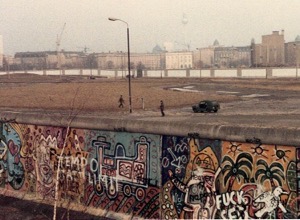
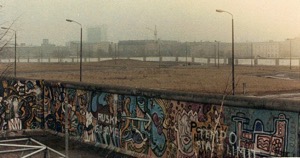
Wooden platforms in West Berlin during the 1980s offered views over the Berlin Wall and into the East German-controlled “No Man’s Land”. Also known as the “death strip” this open area between the inner and outer areas of the Berlin Wall prevented East Berliners from escaping to West Berlin.
East German border guards monitored the “death strip” by patrolling the area on foot, in a vehicle, or from watchtowers. Floodlights, motion detectors, tripwires, alarm systems, mines, barbed wire and guard dogs helped to detect escape attempts.
Besides all the surveillance equipment and security forces, the “death strip” was also home to Adolf Hitler’s Führerbunker. The Führerbunker is where Hitler spent his last days and died in 1945. If you examine the two pictures of the death strip, you will see a mound on the left side about 1/3 of the way from the top. The mound is the remnants of the Führerbunker.
The bunker remained buried and inaccessible until 1987 – 1989. Crews building residential housing and other buildings uncovered sections of the bunker. Damaged sections were filled and sealed, and other sections were destroyed. While the bunker was still standing, but before its scheduled destruction, Robert Conrad, a photographer, risked discovery by repeatedly sneaking into the dark bunker to capture photographs.
In the end, the old bunker complex was mostly destroyed during reconstruction. Any remains of the bunker lie underneath a parking lot. The few existing corridors remaining are sealed off from the public. In 2006, an information board was installed to mark the location of the bunker. Rochus Misch, who was in the bunker at the time of Hitler’s suicide, attended the ceremony of placing the information board.
An explosion at the La Belle discotheque shattered the early morning hours of April 5, 1986, as a bomb hidden beneath the DJ booth ripped through the building at 1:45 AM. Among the deceased were Nermin Hannay, a Turkish woman, and Sgt Kenneth T. Ford CSC 4/502. Critically injured, Sgt James E. Groins CSC 4/502 died of his injuries two months later. At least 230 individuals, including over fifty American service members, suffered injuries.
I think, and after thirty-eight years, I may be mistaken, my unit had been training in Bonnland, West Germany, when the La Belle bombing happened. I found out about the bombing when we returned to Berlin a few days later. The La Belle bombing injured a few members of my unit, 6/502nd.
The bombing left us with an unsettling question—who was responsible? A Berlin police detective I knew told me that Libya was behind the bombing. Just a few days later, on April 14, 1986, Operation El Dorado Canyon, targeted Muammar Gaddafi’s Bab al-Azizia compound.
Even though some articles claim Germany did not have any evidence of who handled the bombing, my Berlin police detective led me to believe otherwise. Just recently, I learned of a few pieces of information I didn’t previously know. Signal Intelligence (Stejskal, 2020) captured between “Libya and the Libyan People’s Bureau—it’s embassy—in East Berlin indicated prior knowledge and subsequent approval of the attack by Col. Moammar Gadhafis government.” (U.S. Delays Underlined as Disco Bombing Suspect Is Freed in Lebanon, 1994).
After the reunification of Germany, the Stasi Records implicated Musbah Eter, leading to his indictment for aiding and abetting attempted murder in the La Belle bombing. The court also indicted and convicted two others—Palestinian Yasser Mohammed Chreidi and Lebanese-born German Ali Chanaa.
Libya eventually compensated Germans, wounded by the bombing, and the family of the Turkish woman who was killed. Americans were not part of the compensation settlement.
Maggie Bird, a CIA operative, retired in a small coastal town in Maine. A murder in her small town, linked to an old covert operation, pulled her back into the life she left behind. Ex-spies teamed up with Maggie to unravel secrets, while Maggie also dealt with the fallout of choices she made long ago.
Maggie is not the typical spy. She’s older, more experienced, and carries the emotional scars from past work. The author, Tess Gerritsen, explored themes like aging, redemption, and regret, which gave Maggie depth.
The book is fast-paced but balances the action scenes with reflective moments so readers can connect with the characters.
I recommend The Spy Coast to anyone looking for an exciting thriller that also has heart, spirit and an unforgettable protagonist.
From 1985 to 1988, I served as a soldier in the United States Berlin Brigade, which was in the American sector of West Berlin. While there, I visited East Berlin a few times. The difference between West Berlin and East Berlin stood out to me. The infrastructure, consumer products and urban aesthetic in East Berlin paled compared to West Berlin. In the East, there were visible East German Police within a block or two of each other. I always felt watched.
I stumbled on the book Stasiland by Anna Funder when I came across an article that mentioned the Stasi Archives, which became accessible to the West once the wall fell.
Funder’s book is a thought-provoking read, which balances journalism with human stories. Funder interviewed former Stasi officers and the ordinary people who had to live their life under surveillance. A society built on fear and mistrust takes a psychological toll on its citizens.
Funder’s writing is informative and although the book is about historical events, the personal stories in a historical context ensure the book is engaging. For those fascinated by the Berlin Wall or the experience of living under a centralized, dictatorial state, Stasiland is an excellent choice.
If you value freedom and truth, you may find this book relevant to events in today’s world.
The Allies, after World War II, split Berlin into four zones, with the British, the French, the Americans and the Soviets each occupying a zone.
The East German government, in 1961, built the Berlin Wall, which prevented East Berliners and East Germans from accessing West Berlin.
Picture taken ~ 1986 on the west side of the Berlin Wall, near Checkpoint Charlie. Pictured: Dan Reid and Keith Green.
The mission of deterring aggression and the defense of West Berlin from the East German Military and the Soviet Union fell to the US Berlin Brigade along with the French and British forces station in West Berlin.
From 1985 to 1988, I served with the US Berlin Brigade. We specialized in Military Operations in Urban Terrain (MOUNT). However, if the East German army and the Soviets (hundreds of thousands of soldiers) attacked West Berlin, the allied forces (~12,000 soldiers) would hold out from a few days to about a week.
I’m not aware of anyone that believed the East Germans and the Soviet Union would attack West Berlin. No one wanted a full-scale nuclear war. I was wrong.
The Berlin Wall fell in 1989, and Germany started reunification. The fall of the Berlin Wall meant the Stasi, the East German secret police and intelligence agency, files were available to the public.
According to the Stasi files, the Stasi and the East German army had plans for the invasion of West Berlin, which included dividing the conquered West Berlin into Stasi branch offices, the number of men to assign to each branch and they even cast medals to award after a successful invasion. (Funder,2014, p. 72).
An invasion of West Berlin depended on Soviet approval and support. The party chairman and the leaders of the Soviet Union would not give their approval or support without a decisive military edge for an offensive war. The economic condition of the communist economy and the cost of the arms race finally caused the Soviet leadership to reject an offensive war in 1987. (Wenzel, 1994)
References:
Funder, Anna. Stasiland: Stories from Behind the Berlin Wall. Kindle Edition.



 Terry Ebaugh